The Role of Robot Sensing and Perception

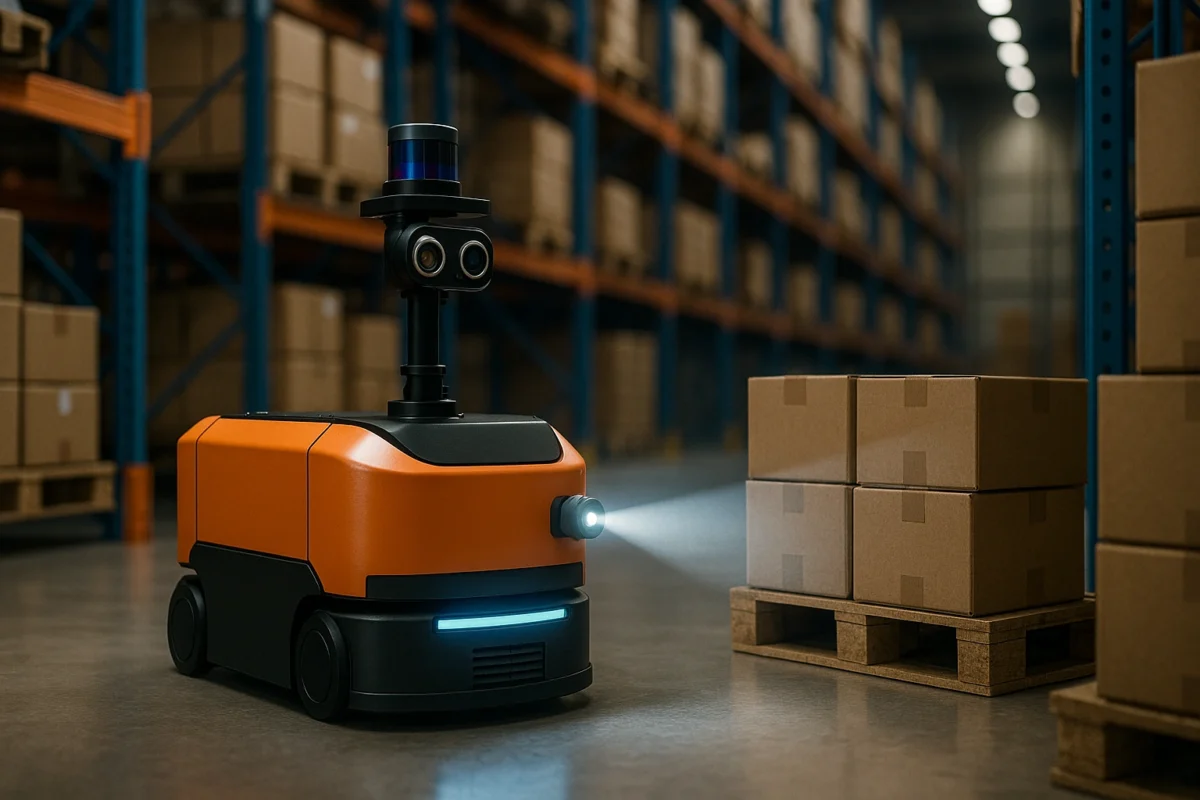
Walk into a modern warehouse today and you’ll find it’s not just about racks and conveyors anymore. What you’ll really notice is the smooth, silent action of robots picking, sorting, and moving with incredible accuracy. It makes you wonder: how are they pulling this off? How do these robots manage to “see” what’s going on, navigate a crowded floor without crashes, and constantly make smart choices? The whole trick comes down to robot sensing and perception.
This is the tech that bridges the gap between simply moving and actually thinking. If we didn’t have it, automation would rely on stiff, unchanging instructions instead of being truly adaptable.
In this article, we’ll break down exactly how robots perceive their environment, check out the key sensors that power smart warehouses, and discuss how AI is completely changing the future of shipping and logistics.
What Is Robot Sensing and Perception?
At its core, sensing and perception means giving robots a way to experience the world around them. Sensors collect raw data from the environment like light, distance, motion, and texture. Perception systems then interpret that data, transforming it into understanding.
Think of it as a robot’s version of human senses. Cameras act as eyes. Force sensors act as touch. LiDAR and ultrasonic devices act as spatial awareness. The combination of these technologies enables robots to:
- Recognize objects and obstacles.
- Estimate distances and dimensions.
- Detect movement and speed.
- Navigate safely in dynamic environments.
- Adapt to unexpected changes on the warehouse floor.
This combination of AI perception and sensory hardware allows robots to make complex decisions without constant human supervision.
The Importance of Perception in Warehouse Robotics
In a warehouse, the environment is rarely static. Forklifts move, workers walk by, pallets shift, and lighting changes. Robots must not only follow paths but also react instantly.
Here’s why warehouse robot vision and perception are vital:
Safety: Robots with real-time obstacle detection prevent collisions with people or objects.
Efficiency: Accurate perception ensures the right items are picked and placed without delay.
Adaptability: Robots can function in changing layouts or when unexpected obstacles appear.
Autonomy: With perception, robots need minimal external guidance, reducing human intervention.
Without perception, robots would be limited to pre-programmed routes and static workflows unsuitable for modern dynamic warehouses.
Also See: How Robots are Changing Warehouse Operations: An Insight
The Core Sensing Technologies Behind Robot Perception
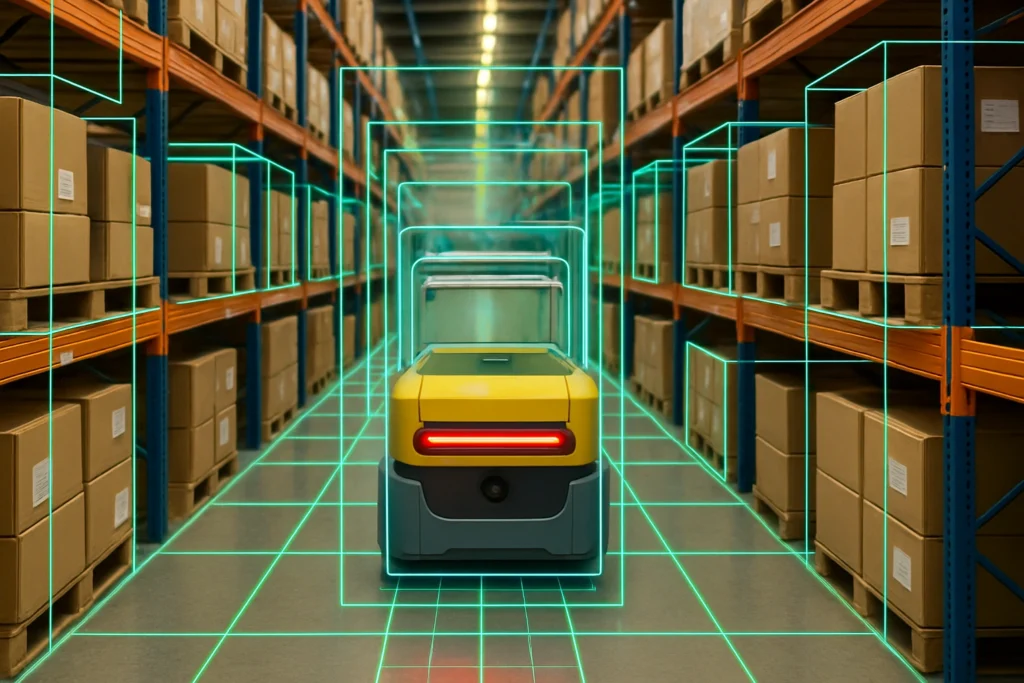
To “see” the warehouse floor, robots rely on a mix of sensors. Each type contributes a unique layer of awareness.
1. Vision Cameras
High-resolution cameras are the most common form of robotic eyes. They capture 2D or 3D images of shelves, products, and obstacles. Combined with computer vision algorithms, cameras allow robots to identify items by shape, color, and label.
Modern AI-driven perception systems use neural networks to recognize even irregular or partially hidden objects. For example, a robotic arm identifying the correct package among many similar boxes by analyzing patterns and textures.
2. LiDAR Sensors
LiDAR (Light Detection and Ranging) uses laser pulses to map the surroundings in 3D. Each pulse measures distance based on how long it takes for light to reflect back.
In warehouses, LiDAR creates real-time 3D maps that help robots:
- Navigate complex aisles.
- Maintain safe distances.
- Detect unexpected obstacles quickly.
It’s especially effective in low-light or dusty environments where cameras struggle.
3. Depth and Time-of-Flight Sensors
Depth cameras or ToF sensors measure how far objects are from the robot. This depth information helps with:
- Accurate grasping and placing of items.
- Detecting shelf height and object positioning.
- Guiding arms during delicate operations.
For robotic picking, this depth perception ensures precision which is essential when handling fragile or high-value items.
4. Ultrasonic and Infrared Sensors
These short-range sensors help robots detect nearby obstacles. They’re simple but reliable tools for collision avoidance in tight spaces. Ultrasonic sensors measure sound wave reflections, while infrared detects heat and movement.
They act as a safety layer, supporting the main vision and LiDAR systems.
5. Inertial Measurement Units (IMUs)
IMUs measure motion, acceleration, and rotation. They help the robot understand its own movement like how fast it’s turning or tilting. When combined with vision and mapping, IMUs ensure smooth navigation even if visual cues are lost temporarily.
How Robots Interpret What They See
Collecting data is one thing. Understanding it is another. Once sensors gather input, perception algorithms analyze and integrate that information into a unified view of the world.
Here’s how AI-driven perception processes it step by step:
Data Collection – Sensors capture visual, spatial, and motion data simultaneously.
Sensor Fusion – Data from multiple sensors is merged to form a single, consistent model.
Object Recognition – AI models identify specific objects, people, or zones.
Mapping and Localization – Robots determine their position on the warehouse floor (often using SLAM (Simultaneous Localization and Mapping)).
Decision-Making – The robot’s control system uses this understanding to plan its next action like picking, avoiding, or navigating.
Obstacle Detection and Environment Understanding
One of the most critical aspects of robot sensing and perception is safety. In busy warehouses, obstacles are unpredictable like human workers, moving vehicles, or fallen boxes.
Robots detect and respond using:
- LiDAR mapping for long-range awareness.
- Cameras for visual confirmation.
- Ultrasonic sensors for close-range alerts.
AI perception models analyze this data to determine if the obstacle is static like a rack or dynamic like a moving person. Depending on the situation, the robot either slows down, changes course, or pauses completely.
This layered detection system keeps operations efficient without compromising worker safety.
Applications of Perception in Modern Warehouses
1. Autonomous Picking and Sorting
Vision-guided robots can identify and handle individual products with high accuracy. Using AI models, they learn to differentiate between items even if they’re slightly misplaced or misaligned.
2. Navigation and Pathfinding
Robots continuously scan their environment, updating routes on the fly. Robot pathfinding systems prevent bottlenecks, ensuring smooth traffic even during peak hours.
3. Collaborative Work with Humans
Cobots (collaborative robots) rely on perception to work safely alongside people. They detect gestures, predict motion, and adjust their speed when humans are nearby.
4. Dynamic Inventory Management
With perception, robots can track item locations and detect misplaced products. This real-time visibility improves inventory accuracy and reduces downtime.
The Role of AI in Robot Sensing and Perception
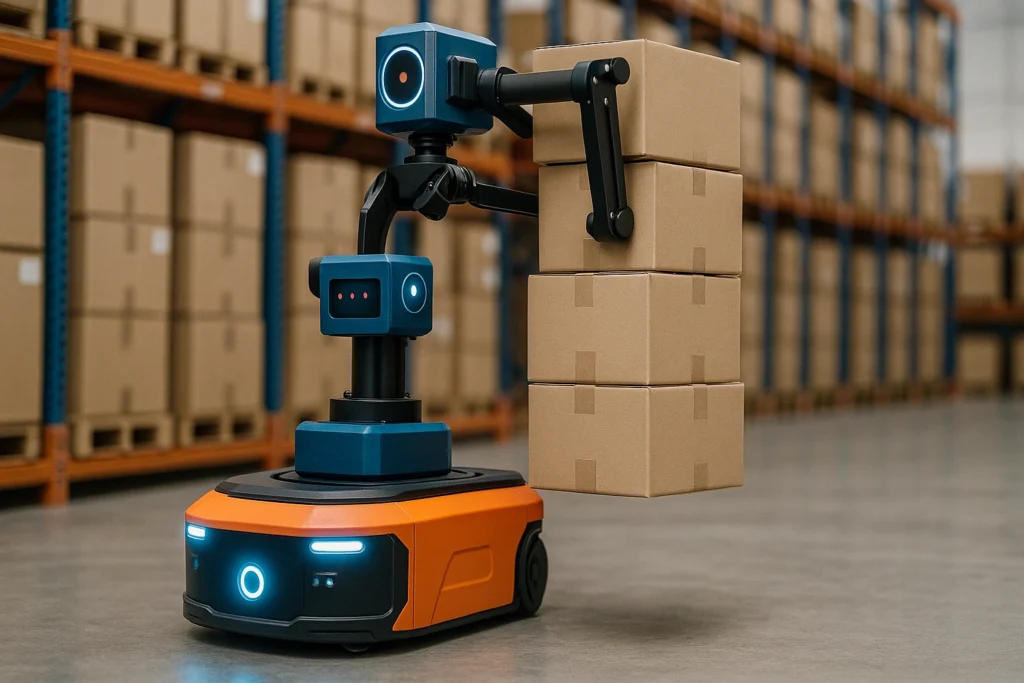
AI transforms raw data into understanding. Machine learning algorithms allow robots to:
- Recognize new object types through training.
- Predict movement patterns in busy spaces.
- Improve accuracy over time through continuous learning.
AI also enables predictive perception where robots anticipate rather than react. For example, a robot might slow down before a corner where it predicts human traffic.
Challenges in Robotic Perception
Even advanced systems face challenges:
Lighting Conditions: Cameras struggle in glare or darkness.
Dust and Debris: LiDAR signals can be scattered by airborne particles.
Data Overload: Managing streams from multiple sensors requires high processing power.
Cost and Maintenance: High-end sensors add expense and need calibration.
Researchers are working on hybrid systems that adapt to these variables, using machine learning to balance accuracy and speed.
Conclusion
The future of warehouse automation depends on how well robots can sense, interpret, and act. Robot sensing and perception enable machines to move beyond mechanical repetition and into intelligent collaboration.
By combining LiDAR, cameras, AI-driven perception, and obstacle detection, modern robots are becoming active participants in warehouse ecosystems—capable of learning, adapting, and improving productivity.
Warehouses that invest in perception-powered robotics today aren’t just automating, they’re future-proofing.
FAQ: Robot Sensing and Perception
Why is sensing and perception critical for warehouse robots?
Because it allows robots to understand and adapt to their environment, improving accuracy, safety, and autonomy.
What’s the difference between sensors and perception systems?
Sensors collect data; perception systems interpret it. Both work together to help robots “see” and make decisions.
How does LiDAR improve robot navigation?
LiDAR provides 3D spatial mapping, helping robots avoid obstacles and plan efficient routes.
Can robots operate without cameras?
Yes, but vision cameras enhance accuracy and flexibility especially for picking and identification tasks.
Are sensing systems expensive?
They can be, but as AI and sensor technology evolve, costs are dropping and accessibility is improving.