
The Role of Autonomous Mobile Robots in Warehouse Automation

Introduction
The world of logistics is continuously evolving, and one of the most significant advancements in recent years is the rise of autonomous mobile robots (AMRs) in warehouse automation. These robots are becoming an integral part of modern warehouses, helping businesses streamline operations, improve efficiency, and reduce costs. With their ability to navigate autonomously and perform essential tasks, autonomous mobile robots in warehouses are transforming how goods are moved, stored, and handled.
In this blog, we will explore the role of autonomous mobile robots in warehouse automation, their impact on warehouse logistics, and how robotic warehouse automation is shaping the future of the logistics industry.
What Are Autonomous Mobile Robots (AMRs)?
1. Defining Autonomous Mobile Robots (AMRs)
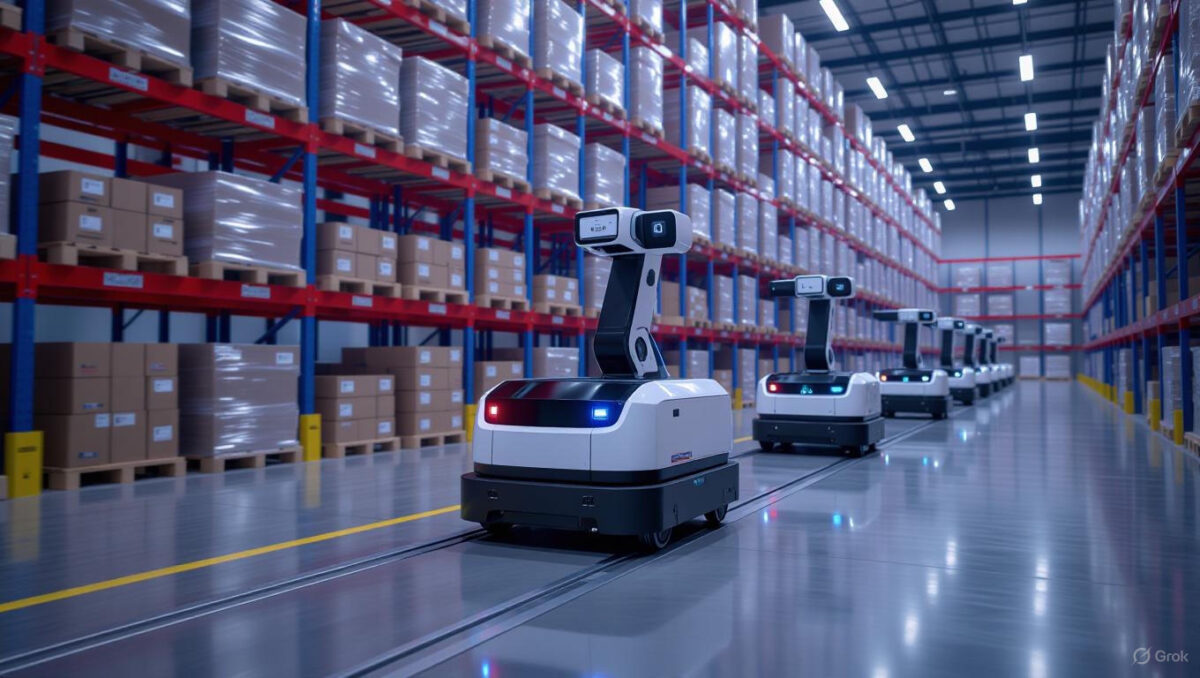
Autonomous Mobile Robots (AMRs) are robots designed to move goods and materials throughout a warehouse without the need for human intervention. These robots are equipped with advanced sensors, cameras, and AI-powered navigation systems that allow them to navigate the warehouse environment, avoid obstacles, and interact with other systems.
Unlike traditional automated guided vehicles (AGVs), which follow pre-determined paths or tracks, AMRs are highly flexible and adaptable. They can make real-time decisions, choose the most efficient routes, and even communicate with other robots or warehouse management systems (WMS) to optimize workflows.
Benefits:
- Autonomous navigation for greater flexibility.
- AI-powered decision-making to adapt to dynamic environments.
- Scalable and adaptable to different warehouse needs.
The Role of AMRs in Warehouse Automation
2. Optimizing Material Handling and Transportation
One of the primary functions of autonomous mobile robots in warehouse automation is material handling. These robots are designed to move products, raw materials, and inventory across the warehouse, reducing the need for forklifts or manual labor. With AMRs handling the transportation of goods, warehouses can free up human workers to focus on tasks like sorting, packing, and inventory management.
AMRs are equipped with advanced navigation systems that allow them to autonomously map out their environment and select the most efficient routes to transport materials. These robots can easily navigate through tight spaces, high-density shelves, and crowded aisles, improving warehouse efficiency and throughput.
Benefits:
- Faster material transportation within the warehouse.
- Increased space utilization with flexible navigation.
- Optimized workflow and reduced congestion in the warehouse.
3. Streamlining Inventory Management and Order Fulfillment
AMRs also play a crucial role in inventory management and order fulfillment. These robots are often integrated with warehouse management systems (WMS) to track inventory in real-time. As AMRs transport items from one location to another, they automatically update inventory records, ensuring accurate and up-to-date data on stock levels.
When it comes to order fulfillment, autonomous mobile robots can retrieve products from storage, deliver them to packing stations, and even assist in sorting them for shipping. This automated workflow speeds up the entire fulfillment process, reduces human error, and increases the accuracy of picking and shipping orders.
Benefits:
- Real-time inventory tracking with automated updates.
- Faster order picking and fulfillment processes.
- Enhanced accuracy in inventory management.
How AMRs Improve Warehouse Efficiency
4. Enhancing Speed and Productivity
By automating the movement of goods and materials, autonomous mobile robots help warehouses achieve greater speed and productivity. Unlike traditional methods, which often require human workers to manually transport goods or wait for machinery to become available, AMRs can work continuously and efficiently, handling tasks in parallel without the need for breaks.
These robots are capable of operating 24/7, enabling round-the-clock warehouse operations. This ability to scale operations without the limitations of human work hours allows businesses to meet growing demand and increase throughput, especially during peak seasons.
Benefits:
- Non-stop operation for increased productivity.
- Reduced delays in material handling and order fulfillment.
- Increased warehouse throughput and capacity.
5. Improving Safety and Reducing Human Error
Autonomous mobile robots also enhance warehouse safety by taking over high-risk tasks traditionally performed by human workers, such as transporting heavy loads or navigating hazardous areas. Since AMRs are designed to work autonomously, they can carry out these tasks with greater precision and without the risk of human injury.
Additionally, robots in warehouse logistics reduce the likelihood of human error in critical tasks like inventory management and order fulfillment. By automating repetitive tasks and minimizing manual interventions, AMRs help reduce mistakes and improve overall operational accuracy.
Benefits:
- Reduced workplace injuries by eliminating hazardous tasks for humans.
- Lower likelihood of human error in inventory and order management.
- Safer work environment with autonomous robots.
The Future of Autonomous Mobile Robots in Warehouse Automation
6. Emerging Trends in AMRs and Warehouse Automation
The future of autonomous mobile robots in warehouse automation is promising, with continuous advancements in AI, machine learning, and robotics technology. As AMRs become smarter and more efficient, they will take on more complex tasks and integrate seamlessly into warehouse workflows.
Emerging trends in AMR technology include:
- Advanced AI for real-time decision-making and route optimization.
- Collaborative robots (cobots) that work alongside humans to handle tasks more efficiently.
- Integration with other automation systems, such as robotic arms and automated sorting systems, to create fully integrated warehouse solutions.
As the demand for more efficient and scalable warehouse operations grows, AMRs will become even more crucial in shaping the future of warehouse automation.
Benefits:
- Smarter robots with enhanced AI for better decision-making.
- Seamless integration with other warehouse automation systems.
- Greater scalability to meet future demands.
Conclusion
Autonomous mobile robots are at the forefront of warehouse automation, reshaping how warehouses handle material movement, inventory management, and order fulfillment. These robots are increasing efficiency, reducing labor costs, and improving safety within warehouses. By automating routine tasks and enhancing workflows, AMRs allow businesses to scale operations, reduce errors, and meet growing customer demands.
As robotic warehouse automation continues to evolve, the role of AMRs in warehouse logistics will only expand, bringing new possibilities for warehouses and distribution centers across industries. The future of warehouse automation is autonomous, and AMRs are leading the way.
Start Implementing AMRs in Your Warehouse Today
Interested in enhancing your warehouse with autonomous mobile robots? Subscribe to our newsletter for the latest insights on robotic warehouse automation, warehouse robotics, and how AMRs can streamline your warehouse operations. Or download our free guide to learn how to integrate autonomous mobile robots into your warehouse today!