Revolutionizing Supply Chains with Warehouse Robotics Solutions

Introduction
In today’s fast-paced global market, supply chains must operate with speed, accuracy, and flexibility to meet the growing demands of e-commerce, manufacturing, and retail industries. Warehouse robotics solutions are playing a pivotal role in transforming how goods are stored, moved, sorted, and dispatched, fundamentally improving warehouse operations and supply chain efficiency.
From automated picking systems to autonomous mobile robots (AMRs), warehouse automation robots are revolutionizing supply chains by enabling real-time data tracking, reducing errors, and increasing throughput. In this blog, we’ll explore how warehouse robotics in supply chain is reshaping logistics and how businesses can harness the power of robotic warehouse solutions to stay ahead in the competitive logistics landscape.
What Are Robotic Warehouse Solutions?
1. Defining Robotic Warehouse Solutions
Robotic warehouse solutions refer to the integration of automated systems and robots in warehouse operations to handle tasks traditionally performed by human workers. These robotic systems are powered by AI, machine learning, and advanced sensors that enable robots in warehouse logistics to navigate through storage areas, retrieve goods, and transport materials across the warehouse.
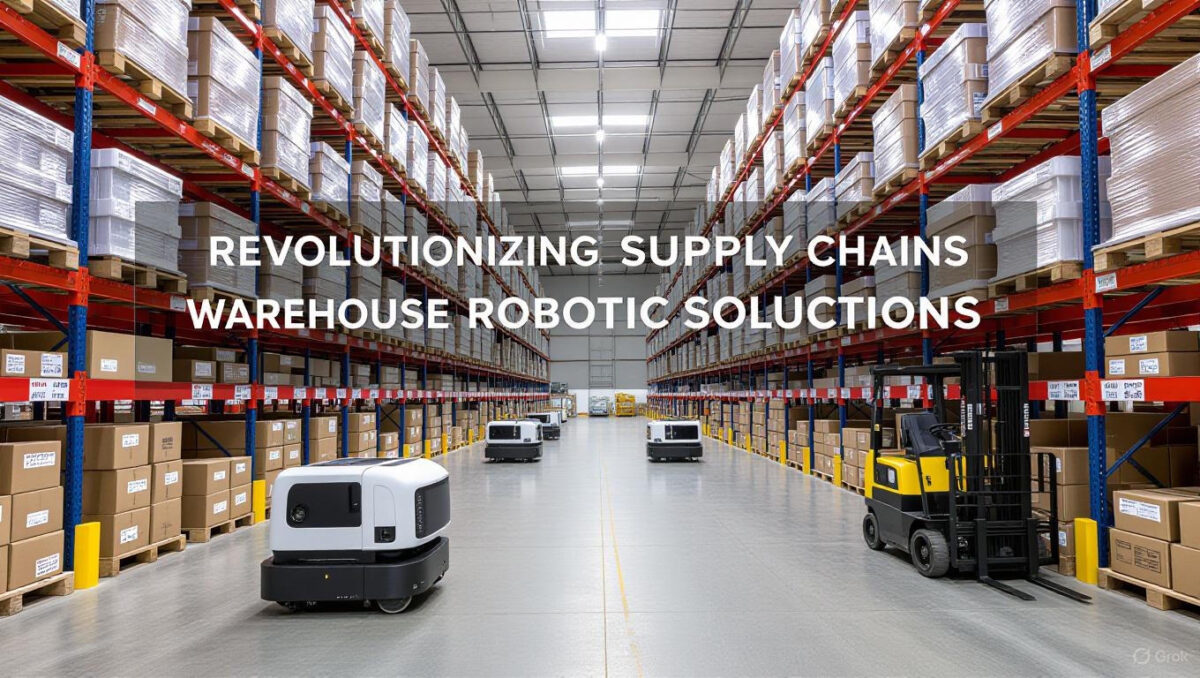
Examples of robotic warehouse solutions include autonomous mobile robots (AMRs) for material transport, robotic arms for sorting and picking, and automated guided vehicles (AGVs) for inventory movement. These systems not only improve efficiency and speed but also significantly reduce the potential for human error and increase the scalability of warehouse operations.
Benefits:
- Faster material handling and movement.
- Increased operational efficiency and scalability.
- Reduced labor costs and human error.
How Warehouse Robotics Are Transforming Supply Chain Operations
2. Improving Speed and Efficiency in the Supply Chain
Robotic warehouse solutions play a critical role in enhancing the speed and efficiency of supply chain operations. By automating inventory handling, picking, and sorting, warehouses can process a higher volume of orders in less time, ensuring faster delivery to customers. Warehouse robots can operate 24/7 without breaks, keeping warehouses running continuously and meeting rising demands.
Warehouse robotics in supply chain offers businesses the ability to handle peak seasons, such as Black Friday or holiday shopping periods, with increased throughput and speed. By reducing manual labor and eliminating delays caused by human workers, warehouse robots companies can ensure the timely and accurate delivery of goods.
Benefits:
- Faster order fulfillment and delivery times.
- Continuous operation to meet demand surges.
- Higher throughput with fewer delays.
3. Reducing Errors and Improving Accuracy
Accuracy is crucial in warehouse operations, particularly when handling inventory management and order picking. Robotic warehouse solutions ensure higher levels of accuracy compared to human workers, reducing the risk of mis-picks, overstocking, or stockouts. Robotic systems use advanced vision systems and AI-powered decision-making to identify and pick the correct products from shelves with precision.
By automating the order picking and sorting processes, warehouses can improve inventory accuracy, leading to fewer returns and better customer satisfaction. The ability of warehouse robots to update inventory in real-time also helps businesses maintain a better understanding of stock levels, improving demand forecasting and supply chain management.
Benefits:
- Improved order accuracy and reduced returns.
- Real-time inventory management for better stock control.
- Fewer mistakes during picking and packing.
The Benefits of Robotic Warehouse Systems in Supply Chains
4. Enhancing Warehouse Logistics Efficiency
The integration of warehouse robots into logistics systems significantly boosts the efficiency of warehouse operations. Robotic warehouse solutions help businesses move products faster and more efficiently, reducing bottlenecks in the workflow. For instance, AMRs can deliver items directly to picking stations, while robotic arms can pick and place products, reducing the time spent manually moving goods around the warehouse.
This automation not only speeds up internal operations but also enhances the flow of goods within the supply chain. By improving warehouse efficiency, businesses can process more orders, ship products faster, and meet customer expectations for timely delivery.
Benefits:
- Increased efficiency in warehouse operations.
- Faster product movement and better workflow.
- More streamlined supply chain operations.
5. Reducing Labor Costs and Improving Scalability
Warehouse automation robots reduce the dependency on manual labor for repetitive tasks like inventory transport and order picking, cutting down on labor costs. As robots take over these repetitive tasks, human workers can focus on more strategic and value-added activities.
Moreover, robotic warehouse solutions enable businesses to scale operations quickly without the need to hire additional temporary workers or expand warehouse space. By adding more robots in warehouse logistics, businesses can meet growing demand and expand their operations without worrying about labor shortages.
Benefits:
- Lower labor costs through automation.
- Scalable solutions to meet growing demands.
- Reduced reliance on temporary workers during peak seasons.
The Role of Warehouse Robotics Systems in Supply Chain Integration
6. Real-Time Tracking and Inventory Management
One of the most significant advantages of robotic warehouse systems is their ability to provide real-time tracking of inventory. By automating the movement of goods through the warehouse, robots in warehouse logistics can continuously update inventory levels, making it easier for businesses to track stock in real-time. This data integration ensures that products are always available when needed and helps prevent stockouts or overstocking.
By providing accurate inventory tracking, businesses can optimize supply chain operations, improve demand forecasting, and enhance overall inventory management.
Benefits:
- Real-time inventory updates for better decision-making.
- Optimized inventory management and demand forecasting.
- Increased supply chain visibility for better control.
7. Future Trends in Robotic Warehouse Solutions
As robotic technology continues to evolve, warehouse robotics systems are expected to become even more advanced. Future trends include the integration of AI-powered robots that can predict inventory needs, collaborative robots (cobots) that work alongside human workers, and adaptive systems that can handle a variety of tasks autonomously. As technology progresses, robotic warehouse solutions will become smarter, faster, and more capable of handling complex logistics tasks.
The integration of robotics in warehouse logistics will continue to play a significant role in improving efficiency and scalability in the supply chain, enabling businesses to stay competitive and meet the growing demands of e-commerce and global trade.
Benefits:
- Smarter robots with AI for adaptive logistics.
- Seamless collaboration between robots and humans.
- Enhanced scalability and flexibility in warehouse operations.
Conclusion
Robotic warehouse solutions are revolutionizing the way businesses operate in the logistics and supply chain industry. By automating key tasks such as order picking, material handling, and inventory management, warehouse robots are improving efficiency, reducing labor costs, and increasing throughput. As these systems continue to evolve, they will play an even more critical role in warehouse logistics and supply chain automation, helping businesses scale operations and meet the increasing demands of the global marketplace.
Warehouse robotics in supply chain is not just about improving efficiency – it’s about creating smarter, more agile supply chains that can quickly adapt to changing demands and deliver better results.
Start Implementing Robotic Warehouse Solutions Today
Interested in learning how warehouse robotics can improve your operations? Subscribe to our newsletter for the latest insights on robotic warehouse systems, warehouse automation, and how robots in warehouse logistics can transform your supply chain. Or download our free guide to start implementing robotic warehouse solutions in your business today!