Integrating AI and Robotics for Smarter Warehouse Management

Introduction
With surging e-commerce volumes and tighter SLAs, warehouses must move faster with fewer errors. AI in warehouse management paired with robotic warehouse systems is redefining operations—from receiving to last-mile handoff—by turning real-time data into automated action.
This article explains how AI orchestrates AI-driven robots and software to deliver smart logistics, reduce cost, and unlock scalable warehouse automation.
What Makes a Warehouse “Smart”?
1. AI as the Decision Layer
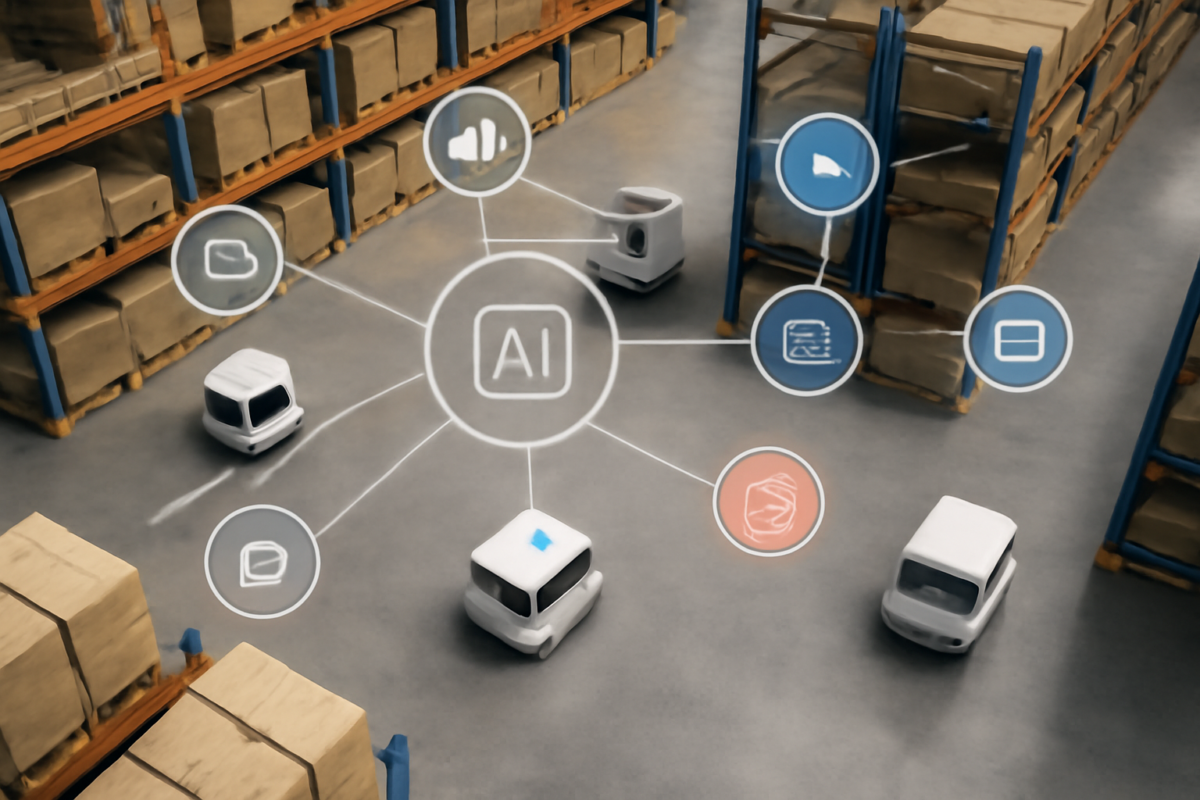
A smart warehouse blends sensors, WMS/WES data, and AI models to assign work to robots and humans in real time. Instead of static rules, optimization engines continuously balance priorities like rush orders, congestion, battery levels, and picker availability.
Benefits:
- Dynamic task allocation that adapts to live conditions.
- Higher throughput with fewer bottlenecks.
- Consistent service levels during demand spikes.
Robotic Warehouse Systems in Action
2. From AMRs to Robotic Arms—One Coordinated Flow
Robotic warehouse systems include AMRs for transport, robotic arms for picking/put-wall tasks, and conveyors/sorters—coordinated by AI. Robots avoid obstacles, batch tasks, and sync with packing and shipping stations to keep takt time steady.
Benefits:
- Fewer manual touches and walking time.
- Faster order cycle times and dock-to-stock speed.
- Safer operations with collaborative robotics.
Key AI Capabilities Behind Smart Logistics
3. Perception, Prediction, and Optimization
- Perception: Computer vision reads barcodes, detects SKU orientation, and audits inventory.
- Prediction: ETA forecasting, congestion prediction, battery/maintenance forecasting.
- Optimization: Route planning, wave/zone picking, slotting, and labor scheduling—updated continuously.
Benefits:
- Higher pick accuracy and fewer misroutes.
- Shorter travel paths and reduced congestion.
- Lower downtime via predictive maintenance.
Integrations That Make It Work
4. Orchestrating Data Across WMS/WES/WCS
AI connects WMS orders, WES workflows, and WCS device controls. Digital twins simulate floor changes (new aisles, racks, SKUs) before deploying. APIs stream telemetry from AI-driven robots to dashboards for actionable insights.
Benefits:
- Faster go-lives with lower integration risk.
- Scenario testing before layout or policy changes.
- Unified visibility for ops, IT, and finance.
Measuring ROI and Scaling Up
5. KPIs That Matter
Track pick rate per hour, dock-to-stock time, order accuracy, cost per order, and robot utilization. Start with one process (e.g., goods-to-person) and expand to replenishment, cycle counts, and returns once KPIs stabilize.
Benefits:
- Clear payback timelines tied to business goals.
- Modular scaling without major capex shocks.
- Continuous improvement via data feedback loops.
The Road Ahead
6. Autonomous Orchestration & Multi-Agent Systems
Next-gen systems will coordinate fleets of robots and humans like air-traffic control—negotiating tasks, rebalancing inventory, and self-healing around disruptions. Expect tighter links to transportation planning for end-to-end logistics optimization.
Benefits:
- Resilient operations under volatility.
- Better SLA adherence with fewer fire-drills.
- End-to-end optimization from warehouse to curb.
Conclusion
Blending AI in warehouse management with robotic warehouse systems turns static facilities into adaptive, data-driven operations. The result is smart logistics: higher throughput, lower errors and cost, and a platform that scales with demand. As models and robots mature, warehouses will move from automated tasks to autonomous orchestration across the entire fulfillment flow.
Get Started
Want a practical rollout plan for warehouse automation with AI-driven robots? Subscribe for templates, KPI scorecards, and a step-by-step guide to logistics optimization—from pilot to scaled deployment.